NASA Curiosity rover successfully land on Mars

The Curiosity Rover

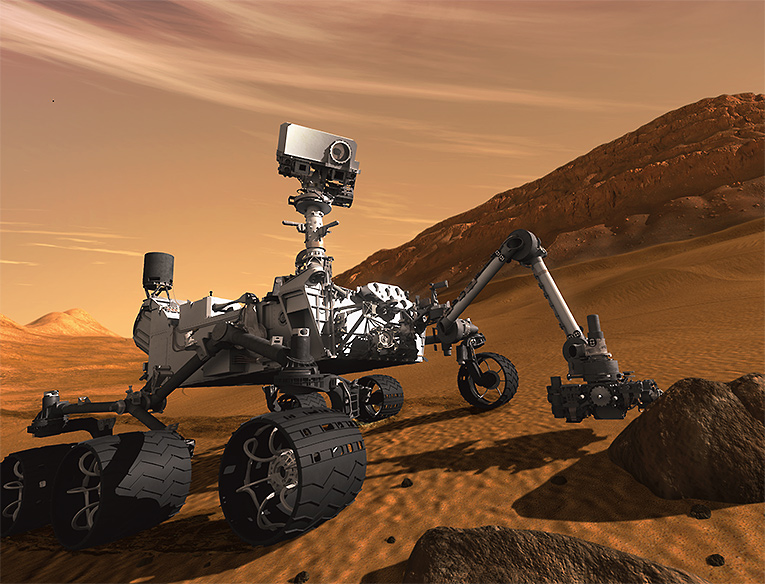
The Curiosity Rover 3D render (Image © NASA)

After traveling for 36 weeks from earth, and approximately 567 million kilometers (352 million miles), it was all down to the last 7 minutes to determine if the long travel was worth the wait.

By some called “7-minutes of terror”, the NASA Curiosity rover had to survive a complicated and intricate procedure to finally touch down on the surface of Mars. After months of waiting, now finally the scientists and engineers can breath a sigh of relief as the rover is securely seated on the surface of Mars.

The intense period called the entry, descent and landing (EDL) phase of the mission began when the spacecraft reached the top of the Martian atmosphere. At this time the Mars Science Laboratory spacecraft, carrying the Curiosity rover was traveling at about 5,900 meters per second (13,200 miles per hour). EDL ended about seven minutes later,  with the rover placed stationary on the surface.

The NASA controllers, and the rest of the world, relied on NASA’s Mars Odyssey orbiter to provide confirmation of a successful landing. Odyssey was turned to the right direction before the landing procedure started so it could listen to Curiosity during the landing. The rover touched down on Mars at 1:31 a.m. EDT.

Continue reading

New satellite launched to improve Europe’s weather service

MSG

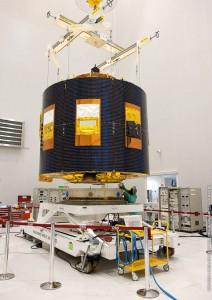
MSG-3 set to ensure quality of Europe’s weather service from geostationary orbit (Image © ESA)

At the end of last week, the latest weather satellite in Europe’s successful Meteosat second-generation project was launched with an Ariane 5 rocket. The launch was made from Europe’s Spaceport at the Guiana Space Centre in Kourou, French Guiana, at 21:36 GMT (23:36 CEST) on Thursday, 5 July.

The satellite is currently being controlled from ESA’s European Space Operations Centre, in Darmstadt, Germany, and on the 15 July, ten days after launch, the MSG-3 will be handed over to the satellite’s owner, the European Organisation for the Exploitation of Meteorological Satellites, EUMETSAT, to commission the payload, once all initial operations are completed.

Continue reading

NASA’s NuSTAR observatory launched this morning

NuStar Observatory

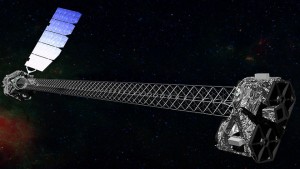
NuStar Observatory. Image: NASA

This morning NASA’s Nuclear Spectroscopic Telescope Array (NuSTAR) launched over the central Pacific Ocean at 9 a.m. PDT (noon EDT). It’s main objective is to unveil secrets of black holes using a unique set of eyes to see high-energy X-ray light from the cosmos.

“We all eagerly await the launch of this novel X-ray observatory,” said Paul Hertz, NASA’s Astrophysics Division Director. “With its unprecedented spatial and spectral resolution to the previously poorly explored hard X-ray region of the electromagnetic spectrum, NuSTAR will open a new window on the universe and will provide complementary data to NASA’s larger missions, including Fermi, Chandra, Hubble and Spitzer.”

Continue reading

Surrey engineers to use Kinect technology to dock satellites

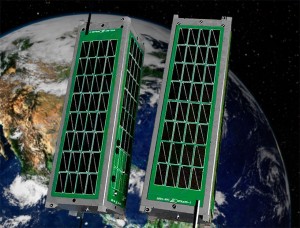
STRaND-2 Docking Nanosatellites

STRaND-2 Docking Nanosatellites

Engineers at the University of Surrey and Surrey Satellite Technology Limited (SSTL) are developing ‘STRaND-2’, a twin-satellite mission, to test a new in-orbit docking system. The system is based on the novel idea of using Microsoft’s XBOX Kinect technology to assist in the alignment during the docking phase. If successful, the new approach has the possibility to change the way space assets are built, maintained and upgraded.

Usually docking control systems are developed for costly missions to the International Space Station, and it has never been employed on the small scale that the researchers now are attempting. They have a vision of using relatively low cost nanosatellites as intelligent “space building blocks”, that could potentially be stacked together and reconfigured to build larger modular spacecrafts, if combined with low cost docking system.

Continue reading

World’s largest radio telescope to spread two continents

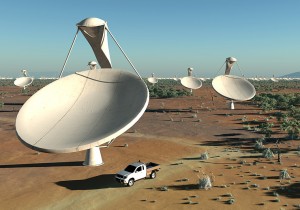
The Square Kilometre Array

The Square Kilometre Array. Image: © SKA

A global science and engineering project named The Square Kilometre Array, has been in intense political negotiations since the project was first introduced. The project intends to build the world’s largest radio telescope, with it’s main objective set to answer big questions about the universe, such as how the first elements heavier than helium was formed and how the first galaxies coalesced. The project is led by the SKA Organisation, a not-for-profit company with its headquarters in Manchester, UK.

At first a scientific panel recommended South Africa over Australia as the best site for the proposed Square Kilometre Array (SKA). However in the latest plans announced on May 25, South Africa and Australia will share the Square Kilometre Array. The project is made up of 3,000 dishes, 15 meters in diameter, and an even larger number of simple antennas and will cost approximately $1,9 billion ( €1,5 billion). Under the deal, South Africa will host the dishes, and Australia will get the antennas.

Continue reading

SpaceX successfully launched it’s Falcon 9 rocket

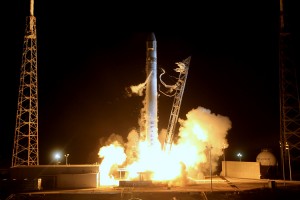
SpaceX’s Falcon 9 launched

SpaceX’s Falcon 9 launched from Cape Canaveral Air Force Station. Image © SpaceX

Early this morning, at 3:44 a.m. Eastern, SpaceX Falcon 9 rocket, successfully launched from Cape Canaveral Air Force Station. On-board was the Dragon capsule heading for the International Space Station. During the journey the capsule will be subjected to a series of tests to determine, and prove to NASA, that the vehicle is ready to dock with the space station.

The mission makes Space Exploration Technologies (SpaceX) the first commercial company in history to attempt to send a spacecraft to the International Space Station. The launch today was flawless, and the vehicle’s first stage performed nominally before separating from the second stage. Shorty there after the second stage successfully delivered the Dragon spacecraft into it’s intended orbit. If required tests are successful, and NASA decides that the Dragon capsule is allowed to approach it’s target, SpaceX will attempt to dock the capsule with the space station on May 25.

Continue reading

SpaceX launch aborted just as engines started firing.

SpaceX Falcon 9 rocket

SpaceX Falcon 9 rocket being checked after launch abort.

The launch of SpaceX Falcon 9 rocket this morning was unfortunately aborted at 4:55am EDT, just a few seconds after it’s nine Merlin engines started up. The internal computers monitors the engines closely during launch, and it found a parameter that was out of bounds on one of the engines. This lead to an immediate cut off of all engines for safety reasons. With a narrow launch window of just one second, a new launch is preliminary set for Tuesday 22 May at 3:44am EDT (07:44am UTC), but this could be subject to change.

Continue reading

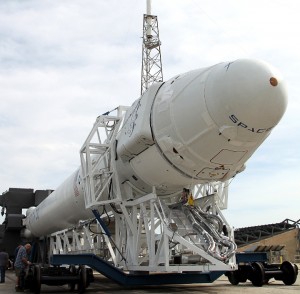
The SpaceX Falcon 9 rocket ready to launch tomorrow

SpaceX Falcon 9 Rocket

Dragon spacecraft and Falcon 9 rocket on it's way to the launch pad. Photo © SpaceX.

The first ever launch of a private vehicle heading for the International Space Station (ISS) is set to launch early morning of May 19. The launch has been pushed back several times, but after a successful launch rehearsal April 30 by the SpaceX launch team, the Falcon 9 rocket is finally ready for take off. The launch is planned for 4:55am EDT (08:55am UTC) and NASA will have live coverage of the event available via NASA TV. It will also be available via SpaceX Webcast.

The mission was originally intended to include only the launch of the Falcon 9 rocket, and tests of the Dragon capsule in orbit. It now also include plans for the Dragon capsule to physically connect to the Space station and deliver supplies such as food, clothing and batteries as well. The journey will also give both SpaceX and NASA the chance to test out the capsule’s sensors and control systems as it approaches the International Space Station, collecting information that can be vital for future missions.

Continue reading

SpaceX to launch April 30 after NASA gives it all-clear

Space X Dragon Capsule

SpaceX Dragon Capsule (© SpaceX)

A private spaceship, built by the company Space Exploration Technologies (SpaceX) of Hawthorne, California, is soon heading for the International Space Station. The launch is planned for April 30, and if successful will mark a historic event, making SpaceX’s Dragon the first commercial American robotic spacecraft to have ever flown and dock with the International Space Station.

The unmanned capsule, named Dragon, will be the first of a new fleet of commercial spacecraft being developed to deliver cargo to the station. The spacecraft will on this first test-run rendezvous with the space station and then be captured by astronauts, operating a robotic arm and offload some cargo. If SpaceX’s April test flight goes according to plans, another Dragon capsule will make the first official cargo delivery run in August.

Continue reading

ESA successfully launch a new smart supply ship

ATV-3 on Ariane

ATV-3 Edoardo Amaldi on Ariane 5

Yesterday at 04:34 GMT (05:34 CET, 01:34 local), ESA successively launched their new ATV from Europe’s Spaceport in Kourou, French Guiana, heading towards the International Space Station. The Automated Transfer Vehicle named Edoardo Amaldi, is the most complex spacecraft ever produced in Europe. It’s mission is to deliver essential supplies, and it will also reboost the orbit of the International Space Station’s while it is attached for about five months.

The 20-tonne payload lifted off with the help of a Ariane 5 launcher, operated by Arianespace. The Ariane 5 have on numerous occasion demonstrated its robustness and reliability, and this time was no exception. It started it’s flight over the Atlantic towards the Azores and Europe, where an initial eight-minute burn of Ariane’s upper stage took ATV-3 into a low orbit inclined at 51.6 degrees to the equator. After coasting for about 42 minutes, the upper stage reignited to circularise the orbit at an altitude of 260 km. About 64 minutes into flight, the supply ship separated from the upper stage, and 25 minutes later ATV-3 started deploying its four solar wings, which when completed marked the end of the launch phase.

Continue reading